


Whether the space is compact or expansive, the way eyewear is displayed directly influences how customers browse, compare, and make decisions. A well planned eyewear display layout does more than organize products. It creates a clear and comfortable shopping experience that guides attention, reduces confusion, and highlights key collections. By matching layout strategy with store size, retailers can turn both limited and complex spaces into environments that feel intuitive, welcoming, and effective for driving sales.
An effective eyewear display layout positions best selling frames at eye level, keeps customer pathways open and easy to follow, balances wall displays with countertop showcases, and adjusts fixture density according to store size. Small optical stores benefit from maximizing vertical space and creating compact, well defined zones. Large stores require clear navigation, strong category separation, and consistent visual merchandising to maintain clarity and improve the overall shopping flow.
In the following sections, we will explore practical layout strategies to help improve both display quality and sales performance.
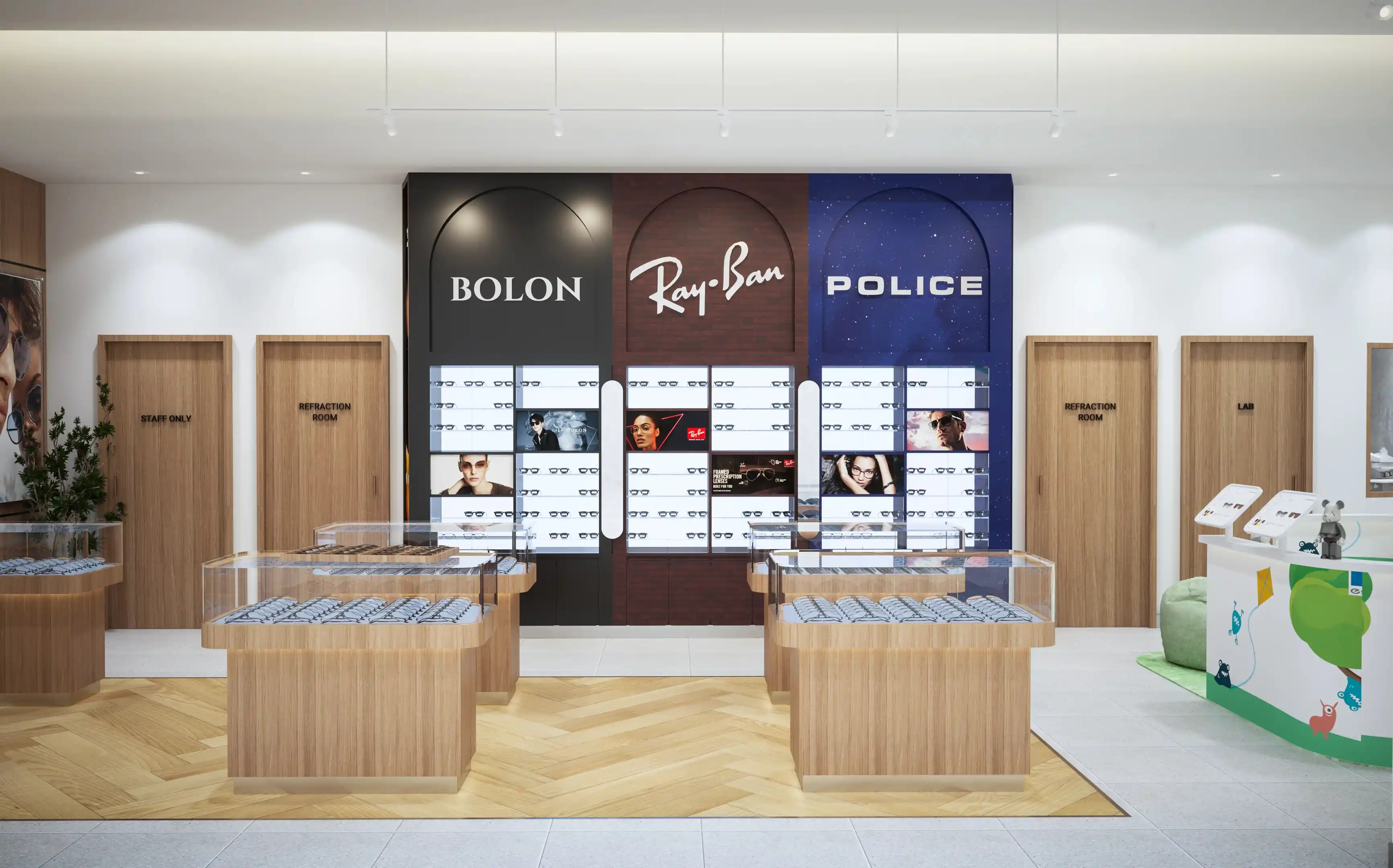
Why Eyewear Display Layout is Important?
Eyewear is a small product with high visual value. Customers need to compare frame shape, color, lens style, material, price, and comfort before making a decision. If the layout is crowded, dark, or confusing, even high-quality eyewear can look ordinary.
A strong eyewear display layout helps retailers:
- Show more frames without making the store feel messy
- Guide customers from entrance to product zones naturally
- Keep premium eyewear at high-impact viewing positions
- Create comfortable try-on and mirror areas
- Improve staff efficiency during product consultation
- Support brand identity across different store sizes
For optical retailers, layout planning should begin before fixture production. The position of wall displays, freestanding racks, mirrors, counters, storage drawers, and lighting will determine how customers move and how products are perceived. ONI Display provides custom optical store fixtures that can be engineered around each store layout, product category, and retail rollout plan.
Small Eyewear Store Layout: Focus on Vertical Space
Small optical stores usually have limited floor area, so every wall, corner, and counter must work harder. The goal is not to display as many frames as possible. The goal is to make a compact store feel clear, complete, and easy to shop.
For small eyewear stores, using vertical space is one of the best ways to save room. Wall-mounted displays, tall cabinets, and slim shelves can hold more frames while keeping the floor open and easy to move around. In compact sunglass areas, a sunglass display rack can also keep popular styles visible without taking up too much space, while built-in drawers help reduce clutter and keep the store organized.
Useful small-store layout tips include:
- Place best-selling frames at eye level near the entrance or main wall
- Use wall displays instead of too many freestanding racks
- Keep the center floor area open for browsing and staff movement
- Use mirrors on side walls to make the space feel larger
- Choose lighter fixture colors if the store feels narrow or dark
- Use compact counters with built-in storage for cases and accessories
A small optical shop should usually avoid oversized islands, deep cabinets, and bulky furniture. These pieces reduce movement space and can make the store feel crowded. Instead, use clean wall systems, narrow display columns, and countertop eyewear holders.
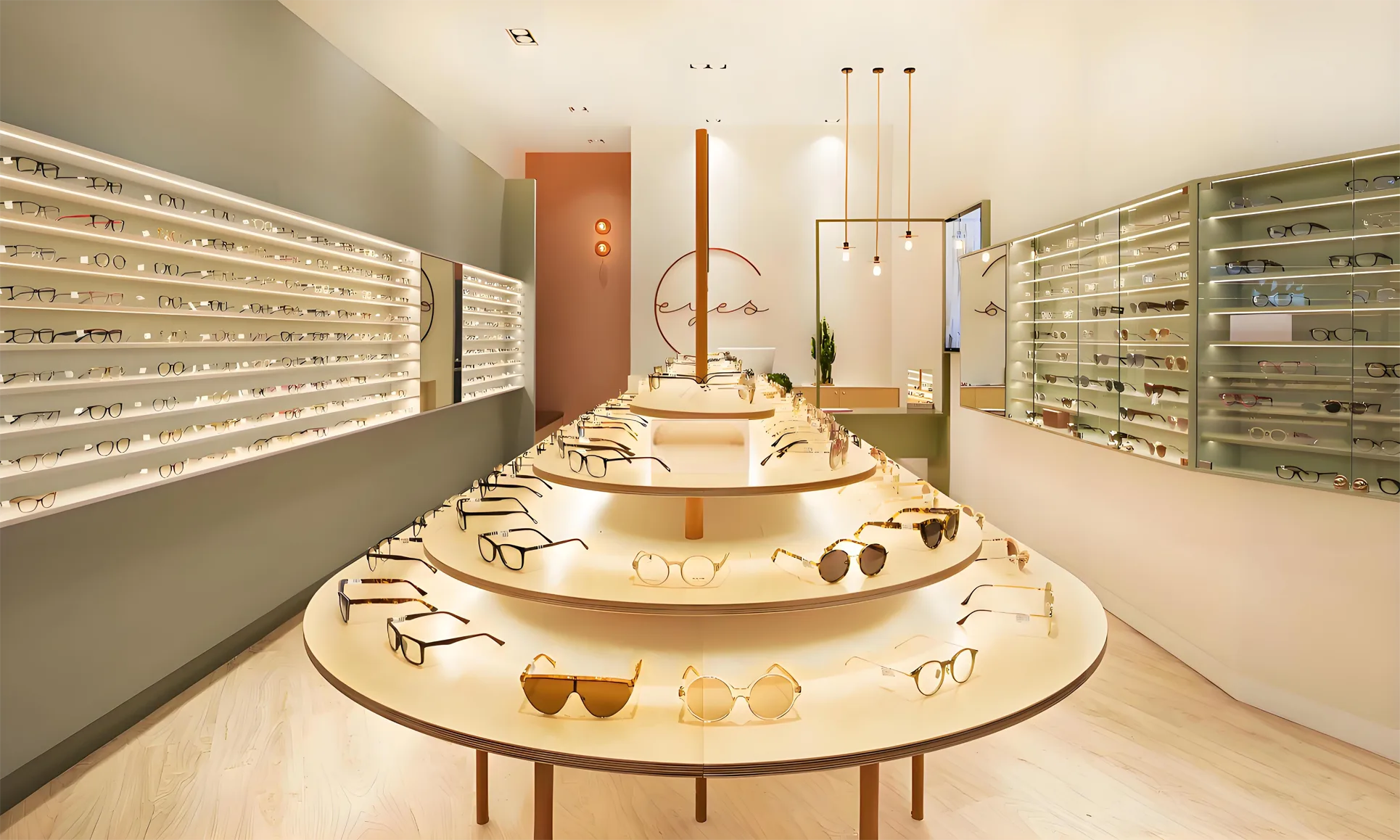
Large Eyewear Store Layout: Create Clear Zones
Large eyewear stores have more space, but they also have a different challenge: customers can feel lost if the layout is not organized. A bigger store needs clear zones, strong navigation, and consistent visual rhythm.
A large optical store can separate products by category, price level, customer group, or brand. For example, one area may focus on prescription frames, another on sunglasses, another on children’s eyewear, and another on premium designer collections.
Effective large-store zones may include:
- New arrivals near the entrance
- Best sellers on high-visibility wall displays
- Premium frames in glass or illuminated cabinets
- Sunglasses near brighter lighting or seasonal campaign areas
- Children’s eyewear in a lower, more accessible section
- Consultation and fitting zones away from the busiest aisle
- Storage and staff service areas near the back or side wall
Large stores can use more freestanding displays, but these fixtures must guide movement instead of blocking it. The main customer path should feel intuitive from the entrance to key product zones, mirrors, consultation counters, and checkout.
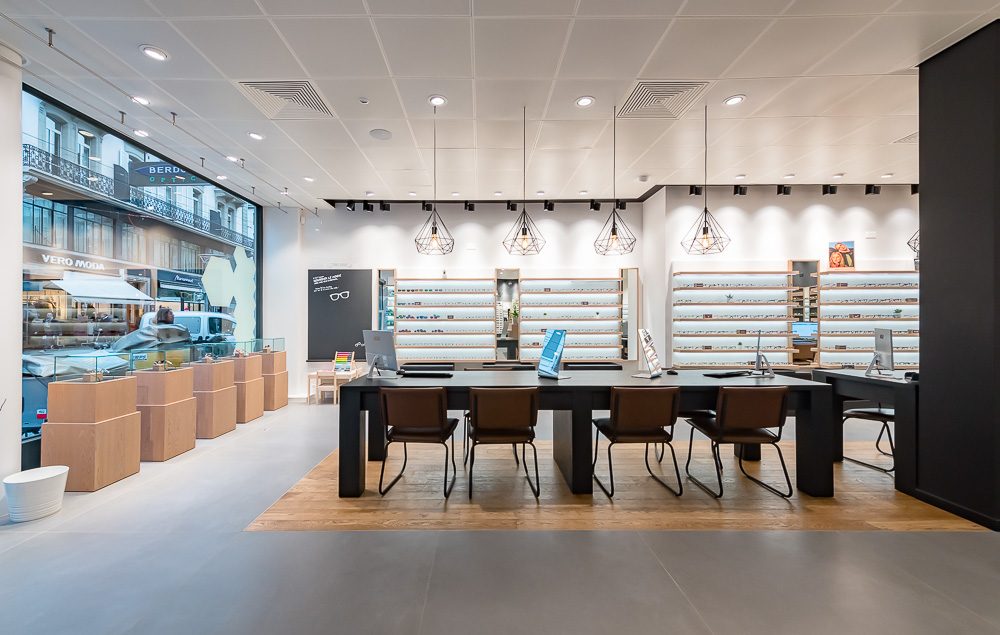
Small vs Large Stores: Key Layout Differences
The best eyewear display layout depends on the relationship between product quantity and customer space. A small store must carefully control display density to avoid clutter, while a large store must focus on clear navigation to prevent customers from feeling lost.
Below is a structured comparison to highlight the key layout priorities for each store type:
| Aspect | Small Eyewear Stores | Large Eyewear Stores |
|---|---|---|
| Core Focus | Maximize space efficiency | Optimize customer flow and navigation |
| Display Method | Wall-mounted display systems | Combination of wall displays and freestanding fixtures |
| Product Organization | Compact categories with limited SKUs | Clear category zoning with broader selections |
| Space Utilization | Vertical storage to save floor space | Spacious layout with balanced fixture placement |
| Counters | Multifunctional counters for display and service | Dedicated service counters and consultation areas |
| Customer Path | Simple and direct browsing paths | Defined circulation routes across zones |
| Floor Layout | Minimal obstruction to avoid crowding | Freestanding islands with sufficient spacing |
| Highlight Strategy | Focus on best sellers and key styles | Hero display areas to showcase featured collections |
| Try-On Experience | Limited but efficient mirror placement | Multiple mirrors and try-on points throughout the store |
| Visual Consistency | Clean and minimal design | Consistent fixture design across departments |
Both store types need to balance display capacity with customer comfort. Too many frames can overwhelm shoppers, while too few can make the store appear understocked. The ideal display density depends on brand positioning, store size, customer behavior, and overall sales strategy.
Fixture Placement Tips for Better Product Visibility
Fixture placement is one of the most important parts of optical retail design. Eyewear should be easy to see from a distance and easy to inspect up close. Wall fixtures, counters, and freestanding displays should support this movement from attraction to evaluation.
Retailers can improve product visibility by following several practical rules:
- Place hero products at eye level whenever possible
- Use consistent spacing between frame holders
- Avoid placing too many similar frames together without category labels
- Keep promotional displays near the natural customer path
- Use locked glass displays for high-value frames
- Keep mirrors close to the products customers are likely to try
- Make sure staff can quickly access drawers, stock, and fitting tools
For sunglasses stores, fixture placement may be more campaign-driven. Seasonal collections, lifestyle branding, and promotional displays often need stronger visual impact. ONI Display also provides custom sunglasses store fixtures for brands that need coordinated wall displays, product islands, and premium eyewear showcases.
Customer Flow and Aisle Planning
Good layout design is not only about where products are placed, but also about how customers move through the space. Even the most visually appealing store can underperform if the customer journey feels crowded, blocked, or unclear. A well planned flow encourages natural movement, improves product exposure, and creates a more comfortable browsing experience.
For small stores, simplicity is essential. The main pathway should remain open and direct, allowing customers to enter, browse key display walls, try on frames, interact with staff, and proceed to checkout without unnecessary backtracking. Reducing physical obstacles and keeping sightlines clear helps the space feel larger and more inviting.
For large stores, flow should be guided rather than left to chance. A looped or clearly defined pathway can lead customers through different product zones in a logical order, ensuring that no key categories are overlooked. Freestanding displays should act as visual anchors that guide direction while maintaining enough space for easy movement.
Aisle width, counter placement, and service zones also play a critical role in both safety and comfort. Sufficient spacing allows multiple customers to browse simultaneously without congestion, while well positioned consultation areas support personalized service without interrupting traffic flow. Thoughtful planning in these areas not only improves the shopping experience but also increases the likelihood of customer engagement and purchase.
When planning aisles, counters, and service zones, retailers operating in the United States can review the 2010 ADA Standards for Accessible Design as a useful accessibility reference. For fixture storage and back of house handling, efficient organization and easy access to inventory are essential to support daily operations, reduce staff workload, and ensure a smooth restocking process without disrupting the customer experience.
Lighting, Mirrors, and Try-On Zones
Lighting can significantly influence how eyewear appears on the face. Poor lighting may create harsh shadows, distort colors, or make mirrors uncomfortable to use. An effective eyewear layout should combine ceiling lighting, wall display lighting, and dedicated mirror lighting to create a balanced environment.
Lighting should support three key goals:
- Make frames clearly visible on displays
- Help customers accurately see how eyewear looks on their face
- Reinforce the store’s brand atmosphere
Small stores can benefit from integrated LED strips within wall fixtures to highlight products without overcrowding the ceiling. Large stores can adopt layered lighting to define different zones, such as premium collections, sunglasses areas, consultation spaces, and promotional displays.
In addition, try-on zones should be comfortable and well-lit, with soft, front-facing lighting that minimizes shadows on the face. Mirrors should be positioned at eye level and, if possible, paired with adjustable lighting so customers can view eyewear under different conditions. This improves confidence in their selection and enhances the overall shopping experience.
Common Eyewear Layout Mistakes to Avoid
Many eyewear stores lose sales because the layout looks attractive in drawings but fails in daily operation. Retail layout should always consider how customers browse, how staff work, and how products are restocked.
Avoid these common mistakes:
- Displaying too many frames on one wall without visual breaks
- Using large freestanding displays in a narrow store
- Putting mirrors too far away from try-on products
- Blocking the entrance with promotional racks
- Using dark fixtures in a small store without enough lighting
- Mixing too many fixture styles in one retail environment
- Forgetting storage space for cases, cleaning cloths, and accessories
A good layout should feel easy for customers and practical for staff. If the team has to constantly move fixtures, search for products, or manage crowded areas, the layout needs improvement.
Start Your Eyewear Display Projects at ONI Display
ONI Display supports optical retailers, eyewear brands, and shopfitting partners in transforming store concepts into fully realized retail environments. With over 25 years of experience and a 30,000-square-meter manufacturing base in Guangzhou, we provide end-to-end solutions—from store planning and CAD detailing to prototyping, fixture production, and global delivery—ensuring every project is practical, scalable, and ready for execution.
Our capabilities cover a full range of eyewear display needs, including custom wall systems, freestanding racks, premium glass cabinets, and lighting-integrated fixtures. Whether developing a compact optical shop or a large-format retail space, we focus on aligning layout, materials, and display systems with brand positioning, product categories, and customer flow to enhance both presentation and sales performance. Contact us now to get a quote for your project.
Summary
Whether an eyewear store is compact or spacious, layout design directly influences how customers browse, compare, and make decisions. A well-planned display goes beyond organizing products—it creates a clear, comfortable shopping experience that guides attention, reduces confusion, and highlights key collections. By strategically positioning best-selling frames at eye level, maintaining smooth customer flow, balancing wall and countertop displays, and adjusting fixture density to suit the space, retailers can transform both small and large environments into intuitive, engaging settings that enhance customer experience and drive sales performance.
Frequently Asked Questions
1. What is the best layout for a small eyewear store?
The best small eyewear store layout uses wall displays, compact counters, vertical storage, clear mirrors, and an open center path. This keeps the store organized without reducing product visibility.
2. How should a large optical store organize eyewear displays?
A large optical store should separate products by category, brand, price level, or customer group. Clear zones, guided circulation, and consistent fixture design help customers browse more comfortably.
3. How many eyewear frames should be displayed in one store?
The ideal number depends on store size, fixture density, brand positioning, and customer flow. A good display shows enough variety without making the store feel crowded or difficult to shop.