Choosing the right material for custom retail display counters can be challenging. Quartz and marble are both popular options for retail countertops, display cabinets, checkout counters, and other custom store fixtures. However, their differences in durability, appearance, maintenance, and cost can make it difficult to determine which material is better for your retail project.
Selecting an unsuitable countertop material can lead to higher maintenance costs, surface damage, inconsistent finishes, and unnecessary replacements. This is particularly important for busy retail environments, chain stores, and multi-store rollout projects, where custom retail fixtures must balance appearance, functionality, and long-term performance.
Understanding the differences between quartz and marble can help retailers make informed material decisions. In this guide, we compare quartz vs marble for custom retail display counters, covering their properties, advantages, disadvantages, costs, and selection considerations to help you choose the right material for your custom store fixtures.
What Is Quartz?
Quartz, commonly known as engineered quartz, is a manufactured stone made from quartz minerals combined with resins, pigments, and other ingredients. It is available in various colors, patterns, and surface finishes, including solid colors and marble-inspired designs. Its consistent appearance makes it a popular choice for modern retail interiors and custom store fixtures.
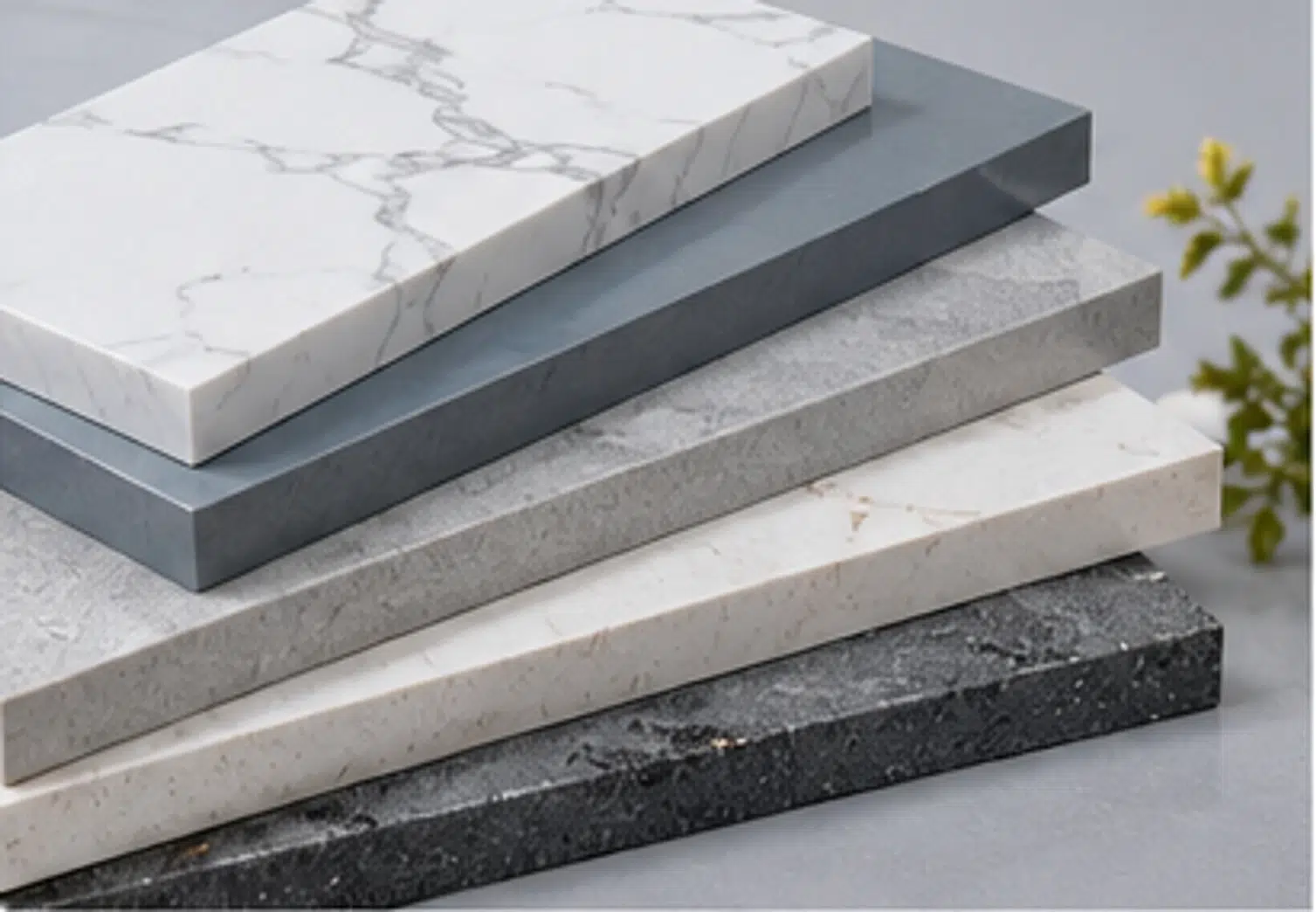
Engineered quartz is widely used for custom retail display counters, checkout counters, reception desks, and other commercial display fixtures because of its durability, stain resistance, and relatively low maintenance requirements. It is especially suitable for retail chains and multi-store rollout projects that require consistent materials and standardized fixture designs.
What Is Marble?
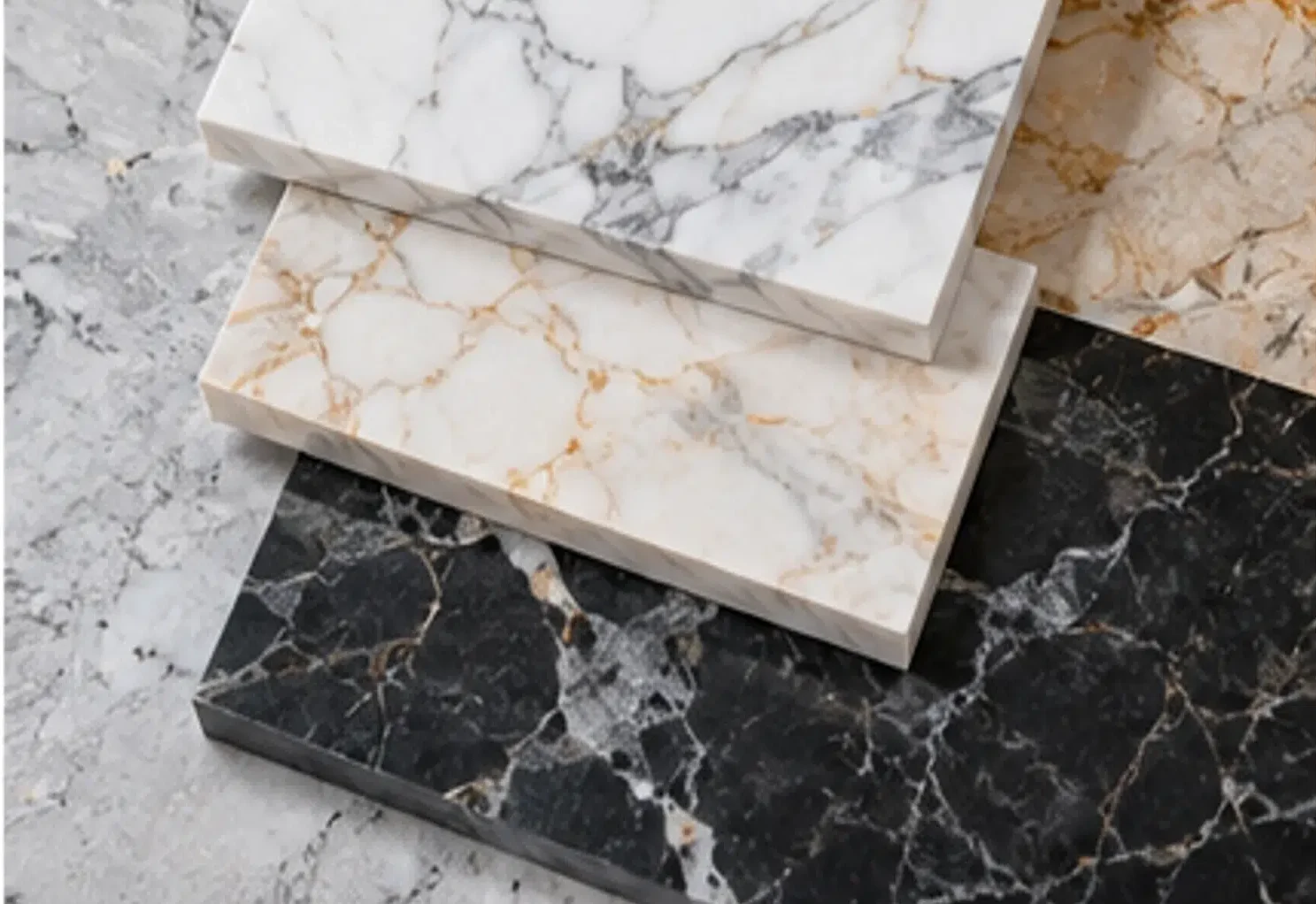
Marble is a natural metamorphic stone formed when limestone or other carbonate rocks are subjected to heat and pressure. Known for its distinctive veining, natural colors, and elegant appearance, marble is frequently used in luxury retail interiors, premium display counters, and decorative store fixtures. Each slab has unique patterns and characteristics, creating a distinctive appearance.
Marble is commonly selected for jewelry display counters, cosmetics showcases, reception desks, and other high-end custom retail fixtures. However, its relatively porous surface and sensitivity to acidic substances mean that it generally requires more careful cleaning and maintenance than engineered quartz.
Quartz vs Marble: Key Differences
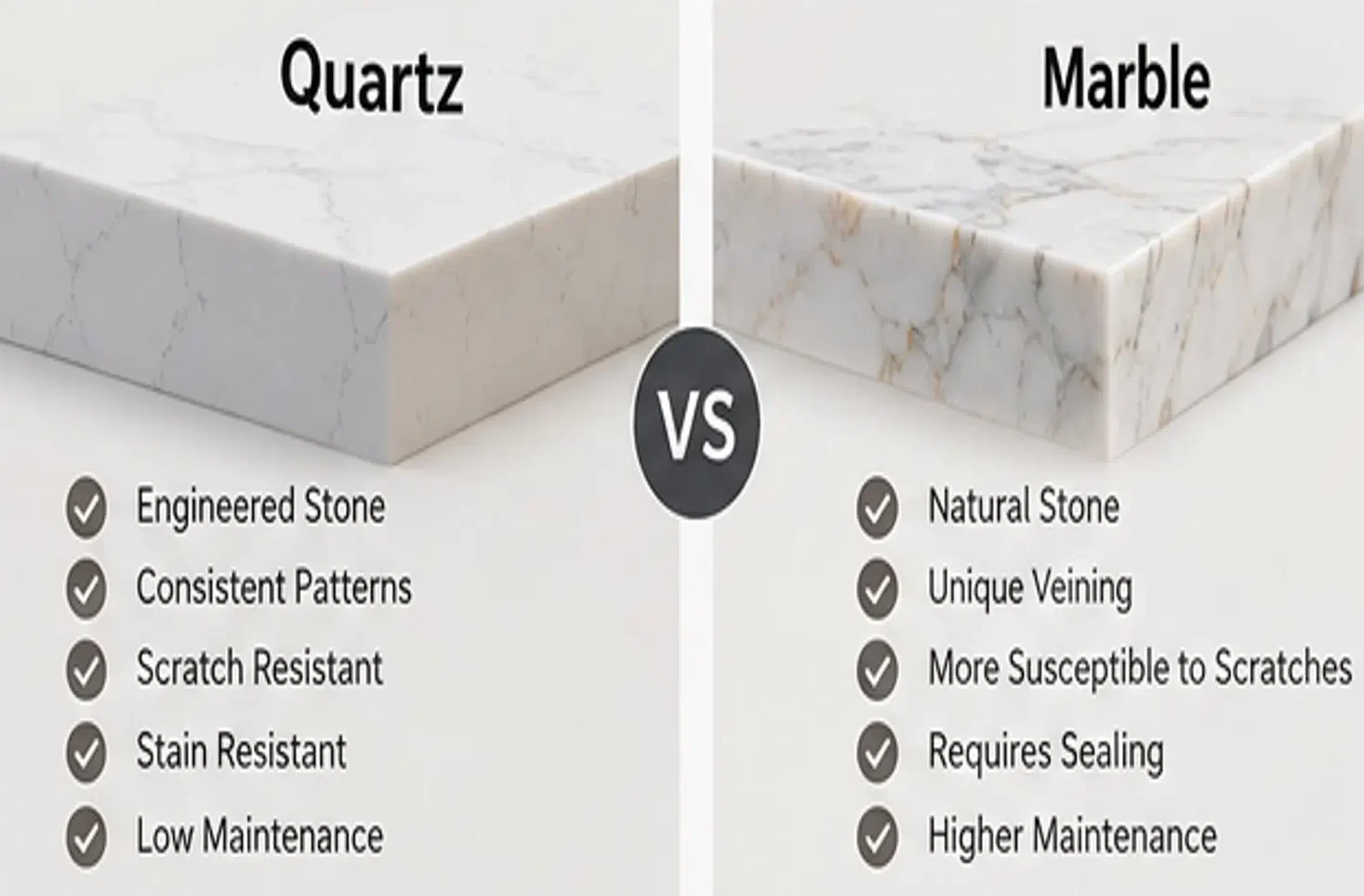
Quartz and marble are both attractive materials for custom retail display counters, but they differ in composition, performance, maintenance, and cost. Understanding these differences helps retailers choose suitable materials for their custom store fixtures based on design requirements, daily usage, and long-term value.
| Feature | Quartz | Marble |
|---|---|---|
| Material Type | Engineered stone | Natural stone |
| Appearance | Consistent colors and patterns | Unique natural veining |
| Durability | Hard and wear-resistant | More susceptible to scratching and etching |
| Stain Resistance | High due to its nonporous surface | Lower; sealing may be required |
| Scratch Resistance | Generally higher | Generally lower |
| Heat Resistance | Moderate; excessive heat may damage resin | Good inherent heat resistance, but thermal shock is possible |
| Maintenance | Easy to clean and maintain | Requires more careful maintenance |
| Color Consistency | Suitable for standardized production | Natural variations between slabs |
| Cost | Mid-range to premium | Varies widely by stone type and grade |
| Best Applications | High-traffic retail counters and chain stores | Luxury counters and decorative retail fixtures |
Overall, quartz is generally more practical for high-traffic retail environments because of its stain resistance, surface durability, and easy maintenance. Marble offers a distinctive natural appearance, making it attractive for premium retail interiors and luxury custom store fixtures.
Quartz vs Marble for Custom Retail Display Counters: 6 Key Factors
When choosing between quartz and marble for custom retail display counters, retailers should consider durability, stain resistance, maintenance, heat resistance, and cost. These factors affect the performance, lifespan, and overall value of custom store fixtures, especially for high-traffic stores and multi-store rollouts. Below, we compare six key factors to help you choose the right material for your retail project.
1. Appearance & Aesthetics
Quartz offers a wide selection of colors, patterns, and surface finishes, including marble-inspired designs and modern solid colors. Its consistent appearance makes it suitable for custom retail display counters that require coordinated designs across different store locations. For retail chains and multi-store rollout projects, quartz helps maintain a uniform visual identity throughout their custom store fixtures.
Marble is valued for its distinctive natural veining and elegant appearance. Each slab features unique variations in color and pattern, making it particularly suitable for luxury retail environments, jewelry display counters, and premium reception desks. For retailers seeking a natural and sophisticated appearance, marble can add distinctive visual character to custom retail fixtures.
2. Durability & Scratch Resistance
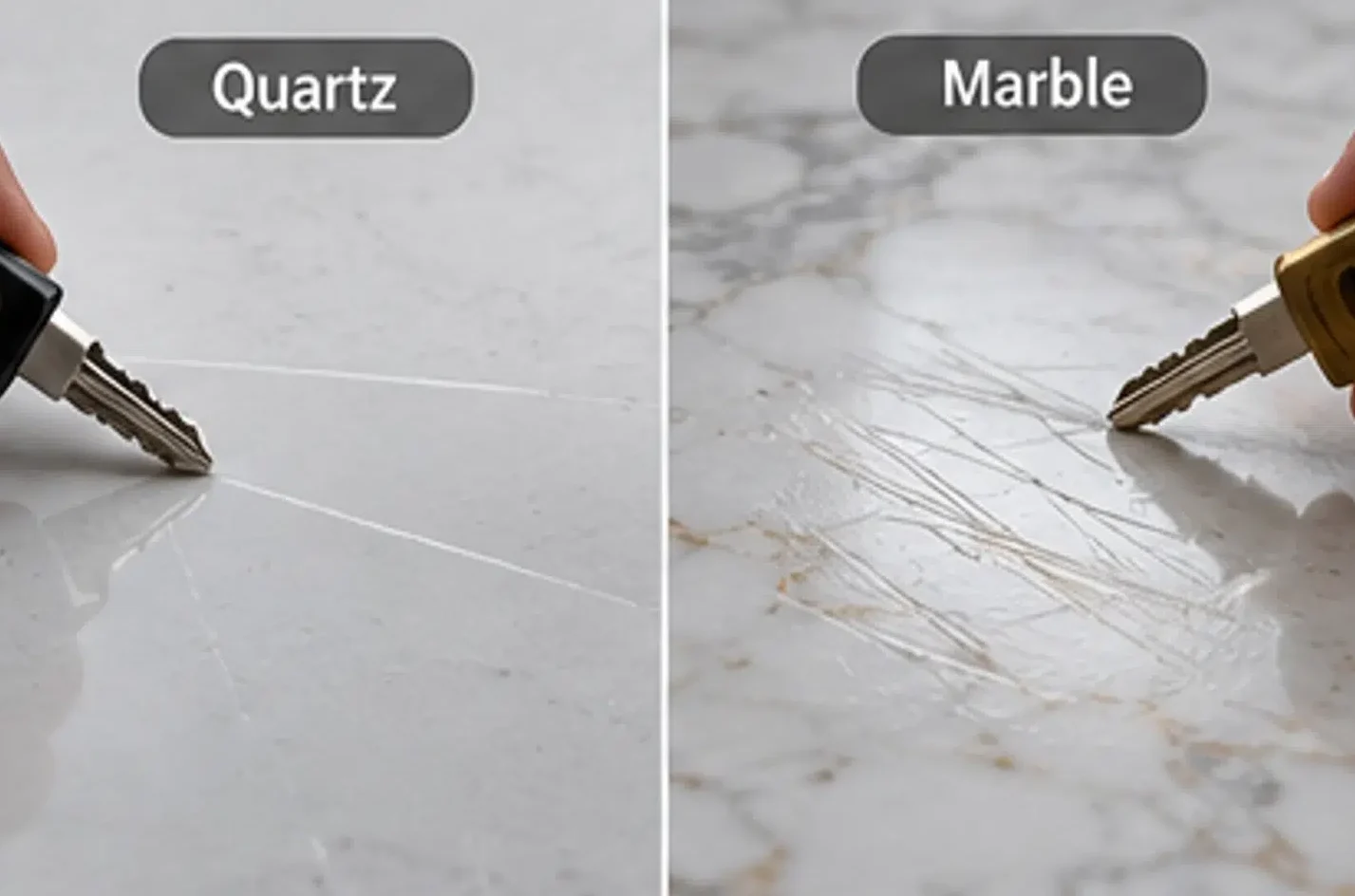
Quartz is generally harder and more resistant to everyday scratching than marble, making it suitable for custom retail display counters exposed to frequent customer interaction and merchandise handling. Its durability is particularly beneficial for checkout counters, cosmetics displays, and other custom store fixtures used in high-traffic retail environments. However, quartz can still chip or become damaged by strong impacts.
Marble is comparatively softer and more susceptible to scratches, surface wear, and acidic etching. Frequent contact with hard objects, metal accessories, and abrasive materials can gradually affect its polished appearance. While marble remains suitable for premium retail display cabinets and decorative counters, it generally requires more careful handling in busy commercial environments.
3. Stain Resistance & Moisture Protection
Quartz features a nonporous surface that provides excellent resistance to common spills and stains. This makes it a practical material for custom retail display counters used in cosmetics stores, perfume shops, and other retail environments where products and liquids are frequently handled. Its stain resistance also helps simplify daily cleaning and maintenance.
Marble is naturally porous to varying degrees and can absorb liquids if not properly protected. Perfume, skincare products, coffee, oils, and other substances may cause staining, while acidic liquids can damage the surface through etching. Although sealing can reduce the risk of staining, it cannot completely prevent surface damage, making marble less convenient for frequently used custom store fixtures.
4. Maintenance & Cleaning
Quartz requires relatively little routine maintenance and can generally be cleaned using a soft cloth, mild detergent, and water. Unlike many natural stone surfaces, engineered quartz does not normally require periodic sealing. This makes it particularly suitable for retail chains and multi-store rollout projects where consistent cleaning procedures and low maintenance requirements are important.
Marble requires more careful maintenance to preserve its appearance. Retail staff should use suitable pH-neutral cleaning products, remove spills promptly, and avoid acidic or abrasive cleaners. Depending on the stone type and usage conditions, marble countertops may also require periodic sealing or professional restoration, increasing the long-term maintenance requirements of custom retail fixtures.
5. Heat Resistance
Quartz offers reasonable resistance to normal indoor temperatures, but excessive heat can damage its resin components, potentially causing discoloration or other surface defects. Hot equipment should not be placed directly on quartz countertops without suitable protection. For most indoor custom retail display counters, quartz provides sufficient performance under normal operating conditions.
Marble has good inherent heat resistance because it is a natural stone. However, sudden temperature changes can still cause damage, and the overall heat performance depends on the countertop finish, installation method, and supporting materials. When designing custom store fixtures with lighting or specialized equipment, both materials should be evaluated according to the project’s technical requirements.
6. Cost & Long-Term Value
Quartz prices vary depending on the manufacturer, thickness, color, pattern, and surface finish. Standard engineered quartz can offer good value for commercial retail projects, while premium designs and complex fabrication may increase costs. Its consistent appearance and relatively low maintenance requirements can make it a cost-effective option for chain stores and repeated custom retail fixture production.
Marble costs depend on the stone variety, origin, grade, thickness, slab size, and fabrication requirements. Common marble varieties may be competitively priced, while rare or premium natural stone can be considerably more expensive. When comparing quartz vs marble for custom retail display counters, retailers should consider material costs, fabrication, installation, maintenance, and long-term replacement requirements rather than the initial purchase price alone.
How to Choose Between Quartz and Marble for Custom Retail Display Counters
Choosing the right countertop material requires balancing appearance, durability, maintenance, and project costs. For retailers planning custom store fixtures, material selection should also consider store positioning, customer traffic, production requirements, and long-term operation.
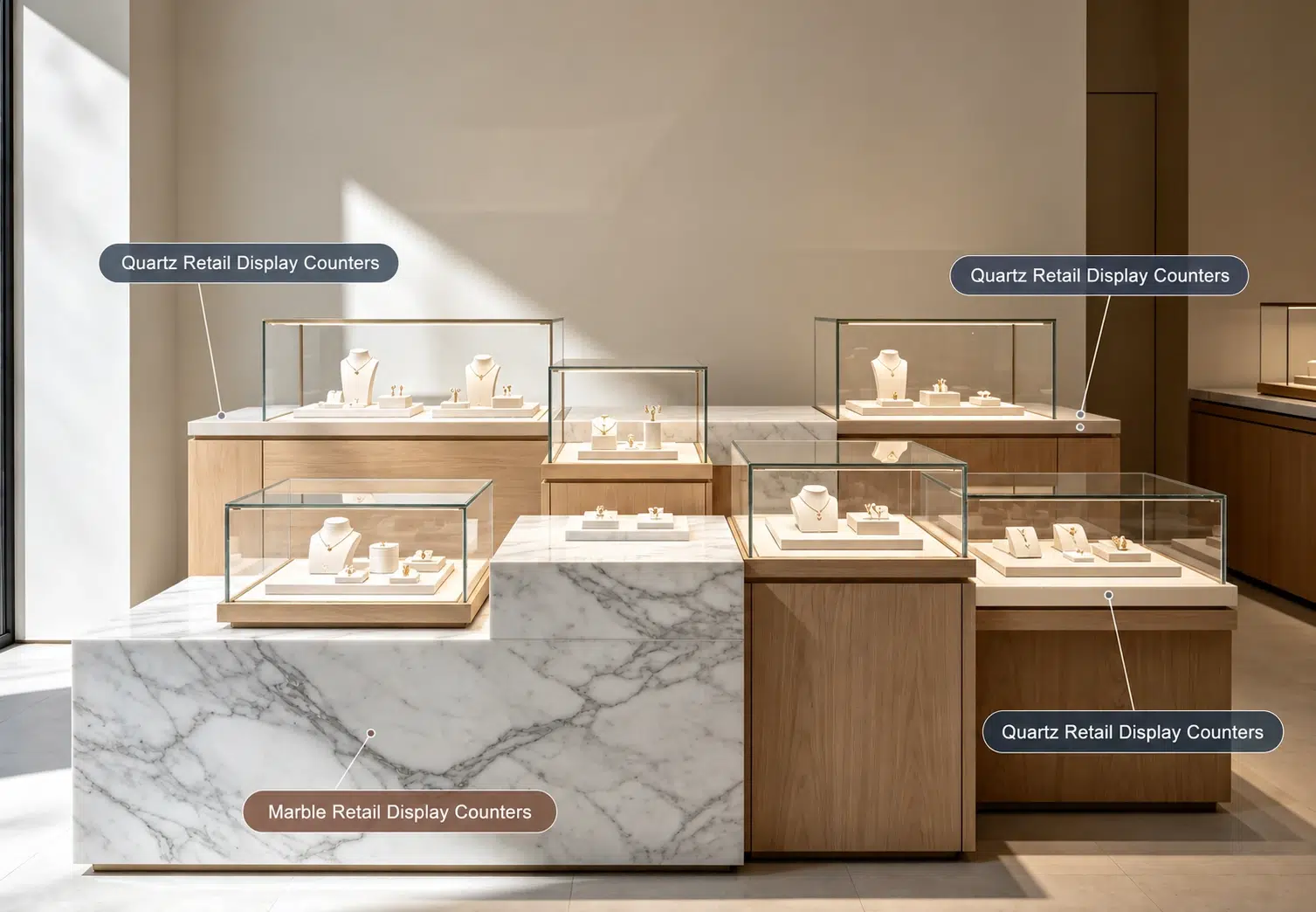
- Store Type & Brand Positioning: Consider your retail environment and brand identity. Quartz is suitable for modern retail stores, cosmetics shops, and commercial spaces, while marble is often preferred for luxury boutiques, jewelry stores, and premium display counters.
- Daily Usage & Customer Traffic: Evaluate how frequently the countertop will be used. Quartz is generally more practical for high-traffic retail display counters, while marble is better suited to decorative or lower-contact areas.
- Maintenance Requirements: Choose quartz for relatively easy cleaning and low maintenance. Marble requires more careful handling, appropriate cleaning products, and potentially periodic sealing.
- Material & Production Costs: Compare material prices, countertop thickness, edge finishing, fabrication complexity, transportation, installation, and long-term maintenance expenses.
- Store Standardization: For retail chains and multi-store rollout projects, quartz offers consistent colors and patterns that support standardized custom store fixture production. Marble may require additional slab selection and approval because of its natural variations.
- Structural & Design Requirements: Consider countertop dimensions, weight, support structures, joints, cutouts, edge profiles, and connections with other materials such as metal, wood, glass, and MDF.
- Material Availability & Project Timelines: Confirm the availability of selected materials, slab dimensions, fabrication requirements, and delivery schedules before starting mass production.
For custom retail display counters and complete retail shopfitting projects, choosing materials during the design and technical drawing stages helps control costs, reduce production changes, and improve the consistency of finished fixtures.
In Conclusion
Both quartz and marble are suitable materials for custom retail display counters, but each offers different advantages. Quartz provides strong durability, stain resistance, consistent patterns, and relatively low maintenance, making it a practical choice for high-traffic retail stores, chain stores, and multi-store rollout projects. Marble offers distinctive natural veining and an elegant appearance, making it ideal for premium retail environments and decorative custom store fixtures. The best material depends on your store design, brand identity, usage requirements, maintenance expectations, and overall project budget.
Frequently Asked Questions
Is quartz or marble better for high-traffic custom retail display counters?
Quartz is generally better for high-traffic retail display counters because it offers higher scratch resistance, better stain resistance, and easier maintenance. It is particularly suitable for checkout counters, cosmetics displays, and frequently used custom store fixtures. Marble can also be used, but it requires more careful cleaning and surface protection.
Is quartz cheaper than marble for custom store fixtures?
Not necessarily. Quartz and marble are available in different price ranges. Standard engineered quartz may cost less than premium natural marble, while some common marble varieties can be less expensive than high-end quartz. The total cost depends on material quality, thickness, fabrication complexity, countertop dimensions, and installation requirements.
Can quartz and marble be used together in custom retail fixtures?
Yes. Quartz and marble can be combined in custom retail fixtures to balance durability, functionality, and aesthetics. For example, quartz can be used for high-traffic checkout counters and frequently used display surfaces, while marble can be incorporated into decorative panels, premium reception desks, or luxury display areas. Combining materials allows retailers to create attractive store interiors while selecting practical surfaces for different applications.
Custom Retail Display Counters for Your Next Project
At ONI Display, we manufacture custom retail display counters, checkout counters, display cabinets, and complete custom store fixtures for cosmetics stores, jewelry shops, fashion boutiques, retail chains, and multi-store rollout projects. Our one-stop retail shopfitting services cover store design, 3D visualization, material selection, technical drawings, custom manufacturing, quality inspection, and worldwide delivery.
Whether you prefer quartz, marble, or a combination of materials, our team can develop custom retail fixtures according to your store layout, brand identity, display requirements, and project budget.
 Contact us today to start your custom display fixtures project.
 WhatsApp/Call: +86 186 2096 3396
 Email: sales1@onishopfitting.com
 Factory Location: Guangzhou, China